 Image 1 of 1
Six-Armed Mahakala is a powerful wrathful protector deity in Tibetan Buddhism, revered as a guardian of the Dharma. Although his appearance is fierce, he does not represent ordinary anger or violence. Instead, his wrathful form expresses enlightened compassion in its most forceful aspect — the power to remove obstacles, subdue harmful forces, and protect practitioners on the path to awakening. Images of Mahakala are often placed near the entrances of shrines and temples, symbolizing his role as a guardian of sacred space and spiritual practice.
In this six-armed manifestation, Mahakala’s arms are associated with the six perfections of the bodhisattva path: generosity, ethical discipline, patience, joyful effort, concentration, and wisdom. His dark blue body symbolizes the changeless and indestructible nature of awakened mind. His tiger skin represents the purification of desire, while his fierce expression shows his uncompromising commitment to cutting through ignorance, ego, and delusion.
Mahakala’s ritual objects carry deep symbolic meaning. His skull cup represents the transformation of negativity into wisdom, while his chopper or vajra cleaver cuts through ego, attachment, and materialistic fixation. His three eyes signify awareness of past, present, and future, and his crown of five skulls represents the transformation of the five poisons — ignorance, attachment, anger, pride, and jealousy — into enlightened wisdom.
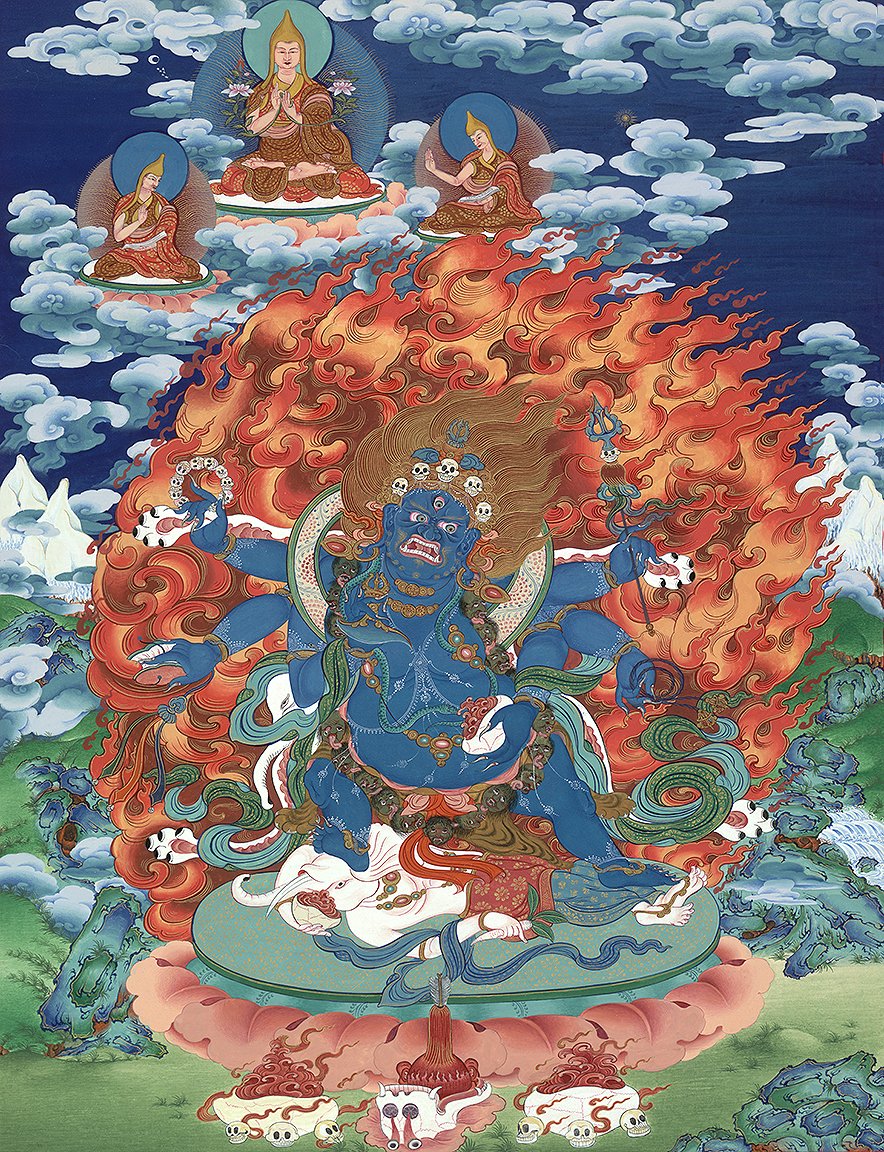
In this artwork, Six-Armed Mahakala stands powerfully within a ring of blazing flames, surrounded by clouds, mountains, and offerings. He tramples an elephant-headed figure, symbolizing the conquest of obstacles, pride, and ignorance. Above him, peaceful lineage figures appear in the clouds, creating a striking contrast between calm wisdom and fierce protection. Together, these elements present Mahakala as a terrifying yet compassionate guardian whose purpose is to protect the teachings and help transform destructive forces into the path of awakening.
Six-Armed Mahakala is a powerful wrathful protector deity in Tibetan Buddhism, revered as a guardian of the Dharma. Although his appearance is fierce, he does not represent ordinary anger or violence. Instead, his wrathful form expresses enlightened compassion in its most forceful aspect — the power to remove obstacles, subdue harmful forces, and protect practitioners on the path to awakening. Images of Mahakala are often placed near the entrances of shrines and temples, symbolizing his role as a guardian of sacred space and spiritual practice.
In this six-armed manifestation, Mahakala’s arms are associated with the six perfections of the bodhisattva path: generosity, ethical discipline, patience, joyful effort, concentration, and wisdom. His dark blue body symbolizes the changeless and indestructible nature of awakened mind. His tiger skin represents the purification of desire, while his fierce expression shows his uncompromising commitment to cutting through ignorance, ego, and delusion.
Mahakala’s ritual objects carry deep symbolic meaning. His skull cup represents the transformation of negativity into wisdom, while his chopper or vajra cleaver cuts through ego, attachment, and materialistic fixation. His three eyes signify awareness of past, present, and future, and his crown of five skulls represents the transformation of the five poisons — ignorance, attachment, anger, pride, and jealousy — into enlightened wisdom.
In this artwork, Six-Armed Mahakala stands powerfully within a ring of blazing flames, surrounded by clouds, mountains, and offerings. He tramples an elephant-headed figure, symbolizing the conquest of obstacles, pride, and ignorance. Above him, peaceful lineage figures appear in the clouds, creating a striking contrast between calm wisdom and fierce protection. Together, these elements present Mahakala as a terrifying yet compassionate guardian whose purpose is to protect the teachings and help transform destructive forces into the path of awakening.