 Image 1 of 1
Rahula is known in Buddhist tradition as the son of Buddha Shakyamuni and one of the earliest novice monks in the Buddha’s community. Born before Siddhartha Gautama renounced worldly life, Rahula later followed his father’s teachings and became known for his humility, discipline, and devotion to learning. His story represents the transformation of ordinary attachment into spiritual commitment, showing how wisdom, meditation, and sincere practice can lead the mind beyond desire and confusion.
In Tibetan Buddhist art, Rahula is also represented as a powerful Dharma protector. In this form, he is not shown as peaceful or gentle, but as a fierce guardian who protects sacred teachings from harmful forces. His wrathful appearance symbolizes the strength needed to overcome ignorance, ego, and spiritual obstacles. Rather than representing ordinary anger, his terrifying form expresses enlightened power directed toward the protection of wisdom and the liberation of beings.
Rahula is often depicted with a serpent-like body, many eyes, nine fearsome heads, flaming hair, and the head of a raven above him. These features symbolize vigilance, supernatural awareness, and the ability to see threats from every direction. The serpent form suggests deep, hidden power, while the raven is associated with watchfulness and protection.
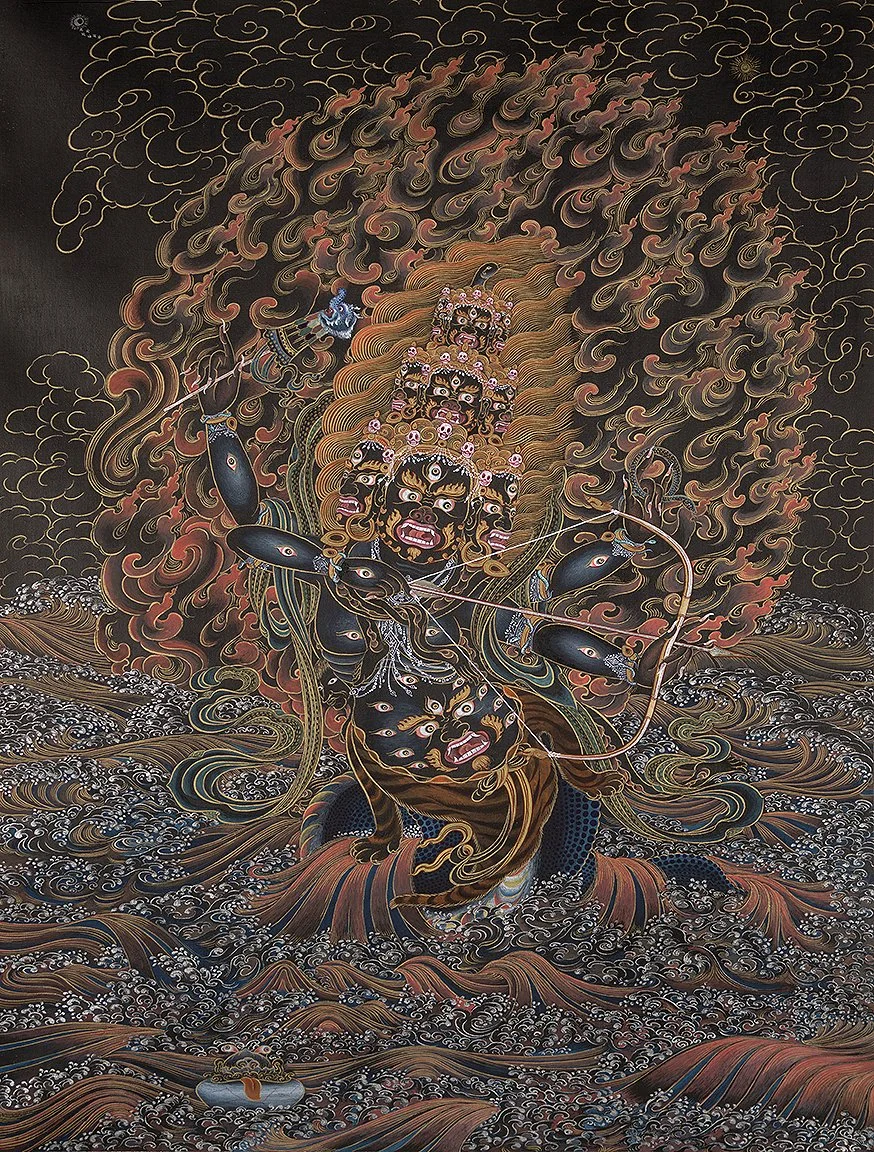
In this artwork, Rahula rises from a dark, turbulent sea, surrounded by swirling waves, black clouds, and flames. His body is covered with watchful eyes, emphasizing his all-seeing awareness and his role as a fierce protector of the Dharma. The dramatic movement of the water and fire creates a sense of cosmic disturbance, as though Rahula is confronting powerful negative forces. His intense expression, multiple heads, and raised weapons present him as a guardian who stands between sacred teachings and the forces that seek to destroy or distort them.
Rahula is known in Buddhist tradition as the son of Buddha Shakyamuni and one of the earliest novice monks in the Buddha’s community. Born before Siddhartha Gautama renounced worldly life, Rahula later followed his father’s teachings and became known for his humility, discipline, and devotion to learning. His story represents the transformation of ordinary attachment into spiritual commitment, showing how wisdom, meditation, and sincere practice can lead the mind beyond desire and confusion.
In Tibetan Buddhist art, Rahula is also represented as a powerful Dharma protector. In this form, he is not shown as peaceful or gentle, but as a fierce guardian who protects sacred teachings from harmful forces. His wrathful appearance symbolizes the strength needed to overcome ignorance, ego, and spiritual obstacles. Rather than representing ordinary anger, his terrifying form expresses enlightened power directed toward the protection of wisdom and the liberation of beings.
Rahula is often depicted with a serpent-like body, many eyes, nine fearsome heads, flaming hair, and the head of a raven above him. These features symbolize vigilance, supernatural awareness, and the ability to see threats from every direction. The serpent form suggests deep, hidden power, while the raven is associated with watchfulness and protection.
In this artwork, Rahula rises from a dark, turbulent sea, surrounded by swirling waves, black clouds, and flames. His body is covered with watchful eyes, emphasizing his all-seeing awareness and his role as a fierce protector of the Dharma. The dramatic movement of the water and fire creates a sense of cosmic disturbance, as though Rahula is confronting powerful negative forces. His intense expression, multiple heads, and raised weapons present him as a guardian who stands between sacred teachings and the forces that seek to destroy or distort them.