 Image 1 of 1
Shantideva was an 8th-century Indian Buddhist monk, scholar, and poet associated with the great monastic university of Nalanda. He is best known as the author of The Way of the Bodhisattva (Bodhicaryavatara), one of the most beloved and influential works in Mahayana Buddhism. A follower of the Madhyamaka philosophy associated with Nagarjuna, Shantideva is remembered for his profound insight into compassion, wisdom, and the bodhisattva path. His writings continue to guide practitioners in cultivating patience, ethical conduct, and the aspiration to work for the benefit of all beings.
Tradition holds that Shantideva possessed the qualities of a bodhisattva from an early age, yet he was also deeply devoted to study, contemplation, and practice. Although some accounts describe him as quiet and underestimated by others, he later revealed extraordinary spiritual understanding through his teaching and writing. He is especially associated with the ideal of combining wisdom and compassion in daily life. His greatest inspiration is said to have been the Bodhisattva Manjushri, who reportedly appeared to him in visions and dreams, guiding his understanding of the Dharma.
Shantideva is often depicted as a learned and contemplative figure, representing scholarship joined with spiritual realization. In Buddhist art, he may appear teaching, holding a manuscript, or seated in meditative composure, emphasizing both his intellectual contribution and his inner discipline. His presence symbolizes the transmission of the Buddha’s teachings through study, reflection, and lived practice.
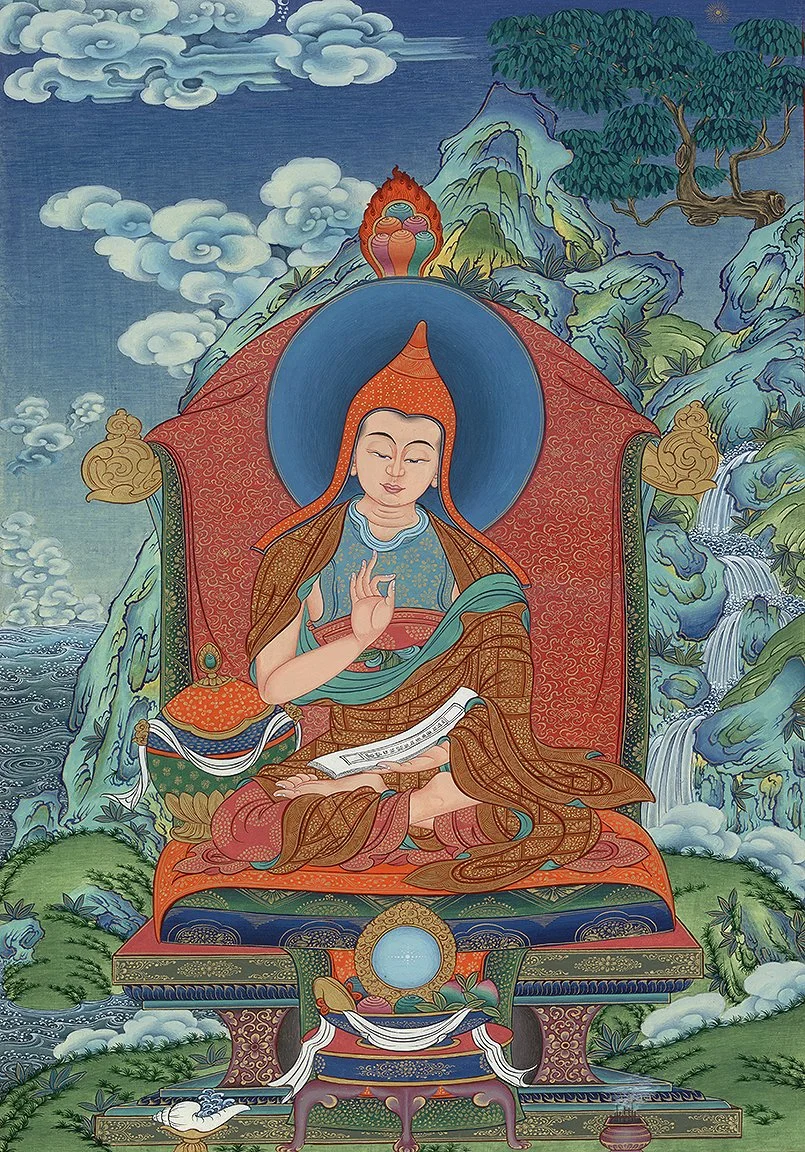
In this artwork, Shantideva is shown seated in full lotus posture upon an ornate throne set within a serene natural landscape of mountains, water, and clouds. His calm expression and composed posture suggest deep reflection and inner stability. His right hand is raised in a gesture of teaching, indicating the transmission of the Buddha’s wisdom, while his left hand supports a sacred text, symbolizing his role as a great scholar and author. The quiet setting around him reinforces the tradition that much of his practice was cultivated in solitude, while the elegant throne and luminous halo emphasize the enduring spiritual importance of his teachings.
Shantideva was an 8th-century Indian Buddhist monk, scholar, and poet associated with the great monastic university of Nalanda. He is best known as the author of The Way of the Bodhisattva (Bodhicaryavatara), one of the most beloved and influential works in Mahayana Buddhism. A follower of the Madhyamaka philosophy associated with Nagarjuna, Shantideva is remembered for his profound insight into compassion, wisdom, and the bodhisattva path. His writings continue to guide practitioners in cultivating patience, ethical conduct, and the aspiration to work for the benefit of all beings.
Tradition holds that Shantideva possessed the qualities of a bodhisattva from an early age, yet he was also deeply devoted to study, contemplation, and practice. Although some accounts describe him as quiet and underestimated by others, he later revealed extraordinary spiritual understanding through his teaching and writing. He is especially associated with the ideal of combining wisdom and compassion in daily life. His greatest inspiration is said to have been the Bodhisattva Manjushri, who reportedly appeared to him in visions and dreams, guiding his understanding of the Dharma.
Shantideva is often depicted as a learned and contemplative figure, representing scholarship joined with spiritual realization. In Buddhist art, he may appear teaching, holding a manuscript, or seated in meditative composure, emphasizing both his intellectual contribution and his inner discipline. His presence symbolizes the transmission of the Buddha’s teachings through study, reflection, and lived practice.
In this artwork, Shantideva is shown seated in full lotus posture upon an ornate throne set within a serene natural landscape of mountains, water, and clouds. His calm expression and composed posture suggest deep reflection and inner stability. His right hand is raised in a gesture of teaching, indicating the transmission of the Buddha’s wisdom, while his left hand supports a sacred text, symbolizing his role as a great scholar and author. The quiet setting around him reinforces the tradition that much of his practice was cultivated in solitude, while the elegant throne and luminous halo emphasize the enduring spiritual importance of his teachings.